



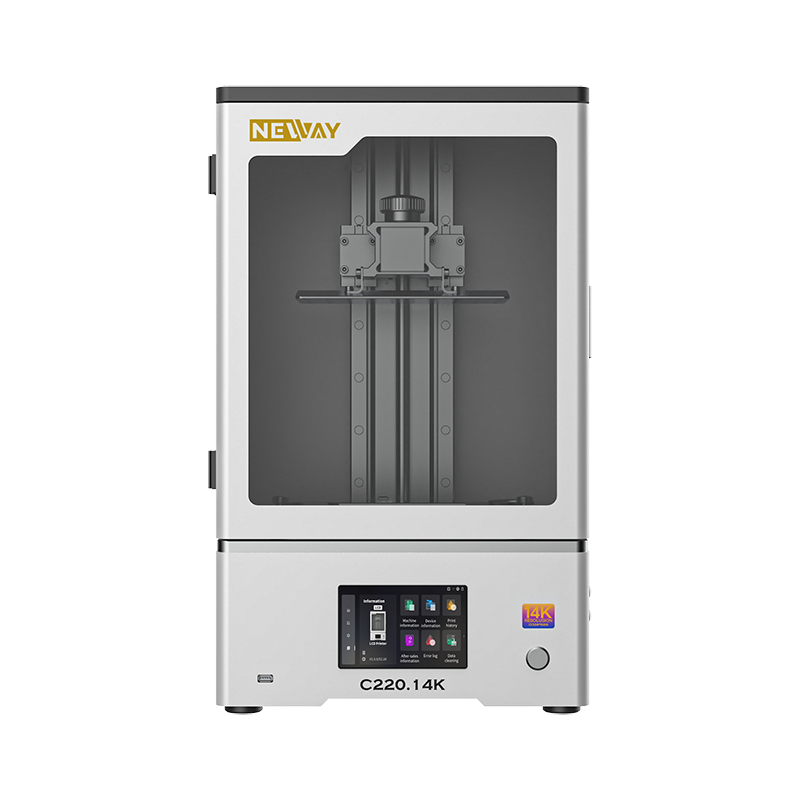
NEWAY’s LCD 3D Printer, with its cutting-edge LCD display technology, not only achieves industry-leading resolution of 50-100 microns (desktop model) and even 30 microns (industrial model), but also makes significant breakthroughs in building format and Z-axis capacity, effortlessly meeting various production needs from small precision parts to large complex structures. It is not only an efficient production tool but also a master of cost control. The high resolution ensures that every print captures the essence of the design accurately, while the larger build format and higher Z-axis capacity give you unprecedented creative freedom, whether it's prototype development, customization or mass production, you can handle it with ease. Choose our LCD 3D printer and let us work together to create a brilliant future in the manufacturing industry!


Frequently Asked Questions
Q: What is LCD 3D printing for jewelry?
A: LCD (or MSLA) 3D printing cures a whole layer at once using a UV LCD screen backlit at 405 nm. It is affordable, quiet and fast, making it the most popular entry and production technology for jewelry pattern making.
Q: What resolution do LCD jewelry printers reach?
A: Our LCD models reach fine X/Y pixel pitches, such as the C220 at about 16.8 x 24.8 µm, with adjustable Z layers of 10-25 µm. That level of detail captures filigree, engraving texture and stone setting seats without hand finishing.
Q: How accurate is an LCD printer compared with DLP?
A: LCD resolution is tied to the fixed screen pixel grid, while DLP uses a moving projector. Modern mono-screen LCD units are accurate enough for 90% of jewelry work; DLP is chosen when uniform illumination and very large, high-volume runs are required.
Q: What resin works with an LCD jewelry printer?
A: You use standard 405 nm UV-curable resins. For jewelry this usually means white wax casting resin or black wax resin for lost-wax investment casting. Always check the resin wavelength (405 nm) matches the LCD light engine.
Q: Is an LCD 3D printer good for a small jewelry studio?
A: Yes. LCD printers cost less than DLP units, need little maintenance and produce casting-ready patterns straight off the build plate. A 24-25 kg unit like the C220 fits a small bench and runs from USB or WiFi with STL/OBJ/SLC files.
